Congressman Steve Cohen, D-TN is our First Amendment Bad Ass of the week.
Mr. Cohen introduced The Citizen Participation Act, a federal anti-slapp bill. The bill describes its purpose as follows:
To protect first amendment rights of petition and free speech by preventing States and the United States from allowing meritless lawsuits arising from acts in furtherance of those rights, commonly called ‘‘SLAPPs’’, and for other purposes.
It is about time.
SLAPP suits are all-too common and are a scourge on our legal landscape. Personally, they have been good for me, as I earn a significant income by defending these kinds of suits, but as much as I love money, I love free speech more (and I'm sure that I could sell that time elsewhere). A SLAPP suit is a "Strategic Lawsuit Against Public Participation." In other words, it is a lawsuit that some hosebag files against a critic -- not because he hopes to win anything, but because the mere filing of the suit is punishment enough for the critic. Lawsuits are expensive, and when a rich douchebag has plenty of money to spend on attorneys's fees, he can afford to sue a couple of critics, thus scaring the bejesus out of anyone else who might criticize him.
The Public Participation Project had this to say about SLAPPS:
Regardless of who is speaking and who is suing, everyone is losing when SLAPPs are allowed to continue. These meritless lawsuits clog the courts, waste resources and contribute to a general culture of litigousness. Instead of answering speech with speech, SLAPP filers answer speech with subpoenas and spurious claims.


 As a lawyer licensed in five states (MA, FL, CA, AZ, and NV) and who practices free speech law nationwide, I am in a position to comment on the relative merits of various states' views on First Amendment principles. Among the many states where I have worked on cases, Flori-duh is the worst. Hands down.

 Back in March, I
 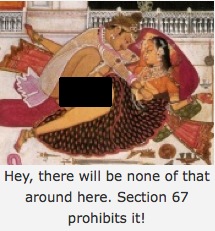 An Indian NGO filed a petition before the Bombay High Court seeking a blanket prohibition on websites that display any "material pertaining to sex." The justification for the proposed ban was that this material "is harmful to the youth of this country in their formative years." (
 If you haven't heard of The Pirate Bay by now, you may want to emerge from that cave, wipe the sleepies from your eyes, and start getting caught up on your backed up WIRED magazines in the bathroom. The Pirate Bay (TPB) is a website run by a few Swedish intellectual property anarchists. TPB provides a comprehensive indexing service for
  We sure do see a lot of intellectual property abuse around here. This has to be the best one yet. Former South Dakota State Representative Ted Klaudt claims that he has a "common law copyright" in his name, and thus any news organization or other publication that uses his name must pay him a licensing fee of $500,000. (

 Congress derives its power to enact copyright laws from the copyright clause, U.S. Const. Art. I § 8, which reads: